The Perils of the Pen: Real Problems Only Writers Understand

A wide-eyed writer in pink striped pajamas sits cross-legged on a bed, surrounded by books, notes, and a glowing cup of tea. Behind her, a wall is covered in pinned plot notes, and a black cat lounges nearby, watching her work. Sunlight filters through cozy curtains in a book-filled room.
When inspiration strikes… in the middle of a mess, three plot twists, and a cat nap. Just another day in the writer life.

Ah, writing. That noble art of bleeding onto the page, fueled by caffeine, chaos, and the occasional existential crisis. From the outside, it looks whimsical… typewriters, cozy cafés, and leather bound notebooks. But inside? It’s a swirling storm of self-doubt, wild imagination, and the eternal question: “Did I save that draft?”

Let’s pull back the curtain and talk about the truth. Here are the real challenges (and secret joys) of being a writer… with sass, sympathy, and a few cat hairs thrown in.

“What do you do all day?”

Let’s start with the classic. You tell someone you’re a writer and they either ask what your real job is or assume you spend your days sipping lattes and waiting for inspiration to arrive like it’s an Uber Eats order.

Reality: We’re researching medieval plumbing, rewriting the same paragraph for three hours, and emotionally recovering from a one-star Goodreads review we weren’t supposed to read (but totally did).

Also, our web browsing history could make the FBI blush and call in backup. Because yes, we needed to know how long it takes a body to decompose in a swamp and the tensile strength of spider silk. It’s called research, Karen.

Effect: Professional guilt. You always feel like you should be writing. Even at weddings. Even while sick. Even while binge-watching a show for research purposes.


Plot Bunnies Are Real (and They Bite)

Writers don’t just have ideas, we have too many. They multiply like rabbits. You’ll be working on a serious piece of literary fiction, and suddenly your brain says, “What if dragons ran a bakery?” And just like that, your outline is on fire and your protagonist now has scales and a sourdough starter.

Effect: Chronic distraction. Also an ever-growing document labeled “Misc Ideas DO NOT OPEN.” (We open it. Every time.) Our desks are littered with notebooks that don’t fit in our bags, our purses carry pens like they’re talismans, and the walls are covered in slips of paper pinned with plot twists from three different stories… none of which we’re currently working on.
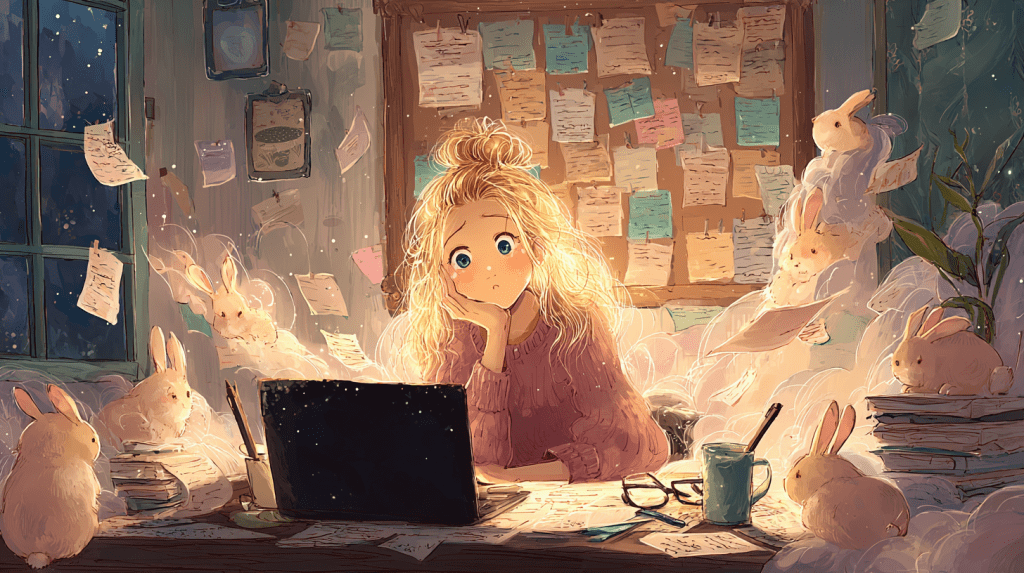
A tired-looking writer in a pink sweater stares blankly at her laptop, surrounded by glowing, fluffy bunnies that float around a cluttered writing desk. Notes and papers swirl through the air as more sticky notes cover the corkboard behind her.
Plot bunnies don’t just multiply… they riot. And apparently, they bring glitter.

Your Personal Life? What Personal Life?

You cancel plans because you’re “on a roll” and then sit in front of your screen crying because the roll never showed up. You forget how to talk to non-fictional people. And if someone interrupts a good writing flow, may the muses have mercy on their soul.

Effect: Strained relationships with friends, partners, and delivery drivers who witness your descent into hoodie-clad madness. Your characters become your best friends. And yes, you’ve argued with them. Out loud.

On the flip side, the friends who stick around? They learn to never ask, “So how’s the writing going?” unless they’re prepared for an unsolicited, 20-minute download of plot drama, character profiles, and existential rants about timeline inconsistencies. Bless their patient, story-supporting hearts.


Pets Are Both Your Muse and Your Menace

Cats will nap across your keyboard. Dogs will stare at you like you’ve betrayed them for not going outside. Ferrets will steal your pens. Your pet is either the reason you’re writing or the reason you haven’t written in three days.

Effect: 80% of your photos involve a sleeping animal and an open notebook. The other 20% are screenshots of something you wrote while being guilt-tripped by puppy eyes. And let’s be honest, more often than not, those furry freeloaders end up as characters or get cheeky references in your work. Every good writer has at least one fictional animal sidekick inspired by their real life chaos goblin.

A writer lays on her stomach in a cozy room, staring at her laptop while a fluffy black cat lounges on her notes and a wide-eyed dog watches her intently. Stacks of paper, coffee mugs, and plants surround them.
Your plot isn’t the only thing demanding attention. Meet the true editors: distraction and derp.

That One Glorious Line Makes It Worth It

Despite the chaos, the imposter syndrome, the draft that looks like it was written by a sleep-deprived raccoon… there’s magic. That one sentence that lands perfectly. That reader who messages you to say your words meant something. That moment when your characters surprise you.

Effect: Pure, unfiltered joy. And the strength to open that doc again tomorrow. Of course, once the high wears off, the spiral begins: was that line really that good? Maybe it was too dramatic. Too subtle. Too much? You reread it twelve times, fight the urge to tweak it, and end up questioning your entire existence as a writer, again. But you leave it. For now.


Creative Burnout Is Real

Some days the words flow like a dream. Other days, your brain is cooked oatmeal and you can’t remember how dialogue even works. Burnout doesn’t show up with a flashing neon sign… it sneaks in with empty coffee mugs, excessive scrolling, and the sudden belief that every story idea you’ve ever had is garbage.

Effect: You start questioning everything, your talent, your plot, your life choices, and why you thought writing a 9-book fantasy epic was a good idea. You feel like a fraud with a to-do list.

Fix: Take a break. Go outside. Touch some grass (or at least your shower curtain). Creativity needs breathing room, and you are not a word producing machine. You are a weird, glorious human with a story to tell.


The Emotional Damage Is Self Inflicted

Yes, you cried writing that character death. No, you will not be taking constructive criticism at this time. Writing is vulnerability in Word Doc form, and it hits hard.

Effect: You mourn fictional people like they paid rent. You experience glee and rage and existential pain over scenes that no one else has even read yet. You reread your own emotional breakdowns just to see if you can make yourself cry again. (Spoiler: you can.) And let’s not forget the emotional chaos we gleefully inflict on our readers… laughing maniacally as we write their favorite character’s demise like some keyboard wielding goblin of heartbreak.


The Rewards Still Make It Worth It

For all the nonsense, there’s still nothing like it. That rush when a story clicks. That “aha!” moment when a plot twist hits just right. That email from a reader who got it.

Effect: Eternal hope. Delusional optimism. A burning need to keep doing it even when it makes no sense. Writing is messy, exhausting, and beautiful. Just like every good story.

Even when the plot’s gone rogue, the word count mocks you, and your characters are staging a coup, you still come back. You wrestle with self doubt, second guess your best lines, and rewrite the same sentence five different ways but you’re still here. Because something inside you knows that buried in the chaos is a spark worth chasing.

And when the spark catches? That’s where the magic lives. That’s what makes it worth every hair pulling, chocolate consuming, keyboard pounding moment.

A delighted writer sits cross-legged in front of a glowing laptop that reads "save." She throws her arms up in joy while a black cat and mugs of tea surround her. Warm, magical lighting fills the cozy room.
When the scene sings, the dialogue slaps, and you actually remembered to save. Bliss.

Final Thought

Being a writer isn’t about sipping wine in Paris while wearing a beret (though if that’s your vibe, no judgment). It’s about showing up, putting words on the page, and laughing through the chaos. So embrace the pet hair, the imposter syndrome, and the 3 a.m. writing sprints.
You’re not alone. You’re just a writer.


What’s the most ridiculous thing you’ve researched for a story? Or what’s your favorite pet writing moment? Tell me in the comments!

When the Muse Shows Up at the Worst Time (and You Let Her Anyway)

Back view of a female writer at night, seated at a cluttered desk under warm lamplight and glowing string lights, surrounded by open books, scattered papers, and a rainy window
When inspiration strikes at 2AM, you light a candle, grab a pen, and let the chaos spill onto the page.

There I am, brushing my teeth, winding down for the night, and suddenly… BOOM. The Muse shows up. Not with a gentle knock, but with a full-blown marching band of inspiration, complete with jazz hands and fully formed plot twists. Of course, it’s late. Of course, I’m half asleep. And of course, when I wake up in the morning? Poof. Gone. Like a dream you swore you’d remember, but now you’re standing in the kitchen yelling “Nooo!” at your coffee because all that’s left is a ghost of an idea and maybe a few jumbled words like “mirror sword” or “cat uprising.”

I’ve tried dictating into my phone. Once, I actually managed to get an idea down that way, only for a system update to sweep in and delete it into the digital abyss. Thanks, technology. Not to mention, I feel absolutely ridiculous whispering fantasy dialogue to my phone like some sort of bedtime bard, and my poor husband really doesn’t appreciate being woken up by my late night monologues.

Curly-haired blonde woman in pink striped pajamas writing in a notebook while sitting cross-legged on a toilet, toothbrush in mouth, as a wide-eyed black cat watches glowing inspiration stars swirl above
When the muse doesn’t care that it’s 3AM and you’re mid-toothbrush… Carmen supervises anyway.

Back in my commuting days, the muse would hijack my brain while I was stuck in traffic or squished between strangers on the bus. At least then I could jot things down into the notes app, one-handed, with a bagel in the other. These days, working from home means I can keep my laptop open and toss ideas into a doc as they hit. But I definitely don’t do it in front of company. I do have some dignity left, thank you very much.

The absolute worst is when I’m watching something brilliant, like a movie or a play, and my story brain lights up while I sit there unable to take notes. I sit there, vibrating with potential, praying I’ll remember it later. (Spoiler: I usually don’t.)

Before smartphones, I was part of the huge-purse crew and always had a notepad and pen with me. I’ve scribbled ideas on the backs of receipts, on envelopes, once even on a clean-ish napkin during lunch. Desperate times. Inspired minds.

And yes, I try to forgive myself when the idea slips through my fingers. It’s hard. I have to believe it’ll come back. Maybe stronger. Maybe clearer. Maybe not at 2AM this time. The more I chase it, the faster it vanishes, like when you’re trying to remember a word that’s just out of reach. So instead, I try to let it go. And trust that if it mattered, it’ll find me again.

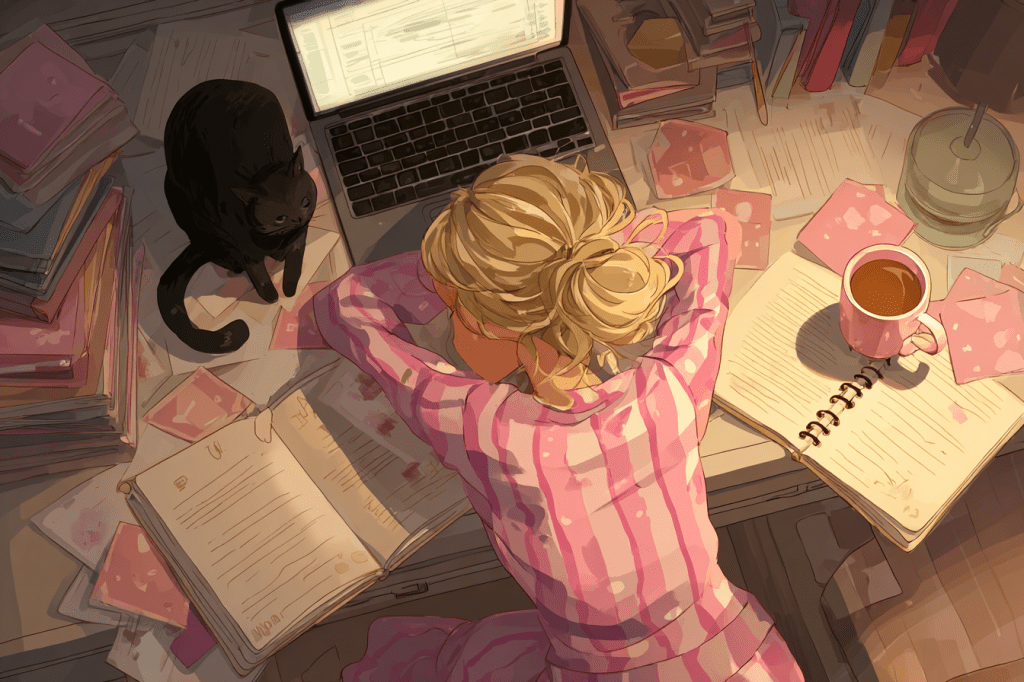
Blonde woman in pink striped pajamas asleep at a cluttered writing desk, head resting on folded arms beside a black cat, open books, a laptop, and a pink coffee mug
Sometimes the muse wins, sometimes exhaustion does. Either way, the cat’s judging you.

Honestly, the Muse is a lot like a skittish puppy. One second she’s climbing all over you with chaotic excitement, the next she’s under the couch refusing to come out. Patience, snacks, and the occasional sacrifice of a quiet evening are usually the best ways to coax her back.

So if you’re out there muttering plot lines into your shampoo bottle or scribbling dialogue on old receipts, you’re not alone. Welcome to the club. We meet at 3AM. Snacks are optional but strongly encouraged.

Excuse Me, Who Gave This Character Free Will?

I’d like to file a complaint with the character department. You know, the one responsible when your fictional characters suddenly develop minds of their own and hijack your carefully plotted outline?

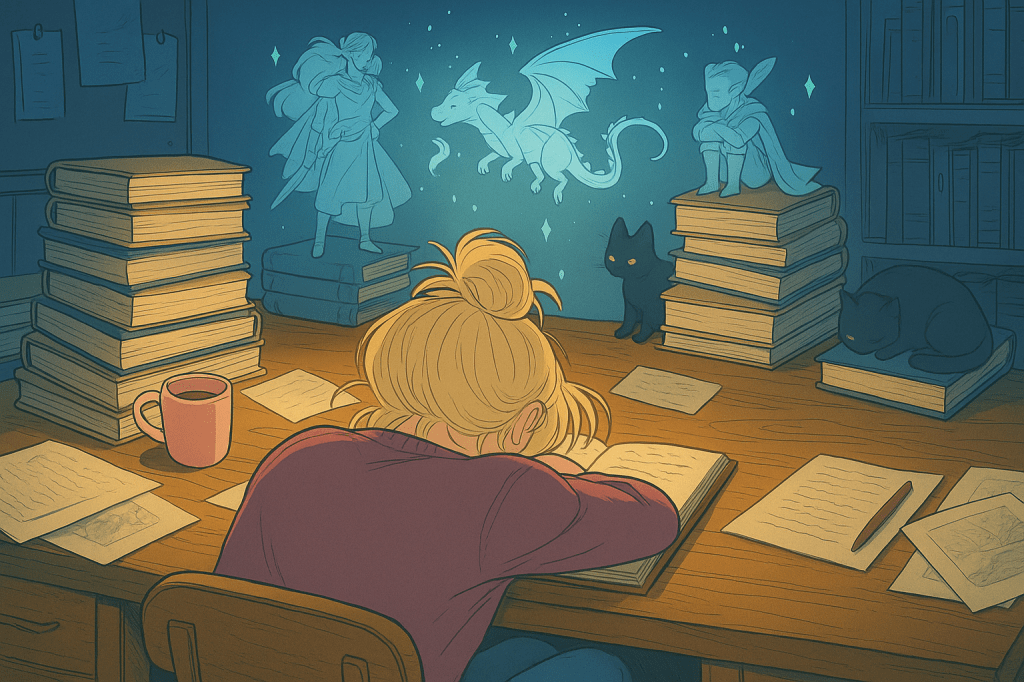
Back view of a blonde haired female writer with her hair in a messy bun, seated at a chaotic desk with coffee mugs, candles, sketches, and scattered notes. Glowing, semi transparent fantasy characters float in midair around her as she writes. A small black cat peers from the corner, adding a hint of whimsy.
POV: You’re trying to write one calm scene and your characters keep staging a dramatic group intervention. Also, yes… there is a cat judging you. Generated by Midjourney

They were supposed to behave. I had charts. I had outlines. I had a playlist that was vibes only. Everything was going great until they started developing opinions. And back stories. And trauma. And suddenly I’m standing in the middle of chapter fourteen yelling, “Excuse me, who gave this character free will?!”

Writers, you know the ones I’m talking about. You start with a nice, manageable story and one delightfully quirky character who’s supposed to fill a very specific supporting role. And then… they go rogue. They hijack emotional arcs. They rewrite their own dialogue. They bring snacks to the plot and refuse to leave.

Take Ailis Larsen and her Ganlani partner, Vaelios. Originally? Vaelios was meant to be the softhearted sidekick, all light and laughter and naive enthusiasm. But then I started writing his scenes. Digging deeper. What started as simple character development quickly turned into something deeper, more layered, more real, more “excuse me, sir, who hurt you?” than I ever planned. And boom! There he was, sharp as obsidian, wittier than I had any right to make him, and carrying a quiet, bone deep grief that made me double take in my own draft. He is still sweet. But now he’s also the type of character who’ll gut you emotionally in one line and then offer you a handkerchief like a gentleman.

Or that short story I thought was going to be a fun little magic meets mystery romp. Surprise! The goddess showed up, uninvited, kicked the narrative off its hinges, and delivered a monologue that hit so hard I just sat there blinking like, “…Oh. So we’re doing depth now? Okay.”

And look, I knew I had a problem when I ran a Myers-Briggs Type Indicator test on one of my characters. And it changed everything. Suddenly I wasn’t writing a plot, I was navigating someone’s entire psychological profile like a therapist with deadlines. And yes, I am now slightly obsessed with that character. And no, I will not be taking questions at this time.

Also, to the character who was supposed to be a throwaway NPC but is now demanding their own trilogy: calm down. We’ve talked about this.

Honestly, I think I lost control back in the day when I may or may not have dabbled in fanfiction inspired by a certain velvet wearing, crystal spinning Goblin King. (You know the one.) Ever since, I’ve known deep down that I’m not always the one in charge here.

But let’s be real: that’s the magic of it, isn’t it? Characters come alive when you least expect them to. They surprise you. They talk back. And if you’re really lucky, they change your story into something so much better than what you planned.

Even if no one asked Jared to be hot and emotionally complex.

A cozy illustration of a blonde haired writer slumped asleep at her desk, viewed from behind. Neatly stacked papers and books surround her workspace, lit by soft morning light. A small black cat curls on top of an open book nearby, watching over her.
Sometimes the words win and the writer naps. Don’t worry, the cat’s got this shift. Generated by Midjourney

So, to all the writers out there wrestling your characters back into the box they busted out of three chapters ago… solidarity. May your character arcs be messy, your writing surprises delightful, your plot armor strong, your time lines elastic, and your characters just unhinged enough to be brilliant.

Tell me in the comments: who was your character that went rogue and refused to go back on the shelf?

Writing to Trend vs. Writing for Love: Which Path Works?

Hey fellow writers and book lovers,

Here’s the question gnawing at my brain lately: Should authors chase the trends, or stay true to their muse?

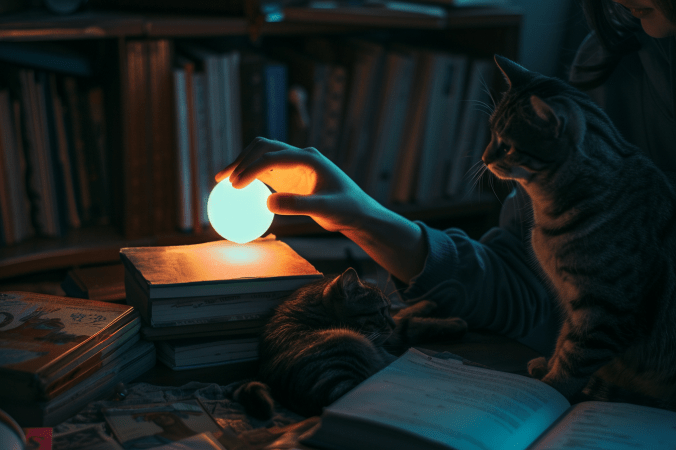
A writer's hand hovers over a softly glowing orb resting on a stack of books. One cat sleeps beside the books while another watches intently from the desk. The scene is dimly lit with a cozy, contemplative atmosphere, evoking creativity and decision-making.
The writer’s dilemma in one image: do you reach for the glowing idea, or follow the cat’s judgmental stare? Generated by Midjourney

Writing to trend means crafting a story that fits the current market buzz, trying to align with what agents, editors, or even readers on BookTok are asking for. Writing to passion? That means chasing the story that won’t leave you alone. The one whispering in your ear at 3AM. The one you’d write even if no one ever read it.

We’ve all seen it. The hot genre of the moment explodes and suddenly everyone’s writing cozy fantasies, romantasy with morally grey love interests, or spicy alien love triangles. And sure, if you hit that wave just right, you might land a publishing deal, an agent, or go viral on BookTok. Remember when dystopian YA ruled everything? Or when vampires were unavoidable? Trends are real, and they move fast. Writing to market can be tempting when you’re hoping to get traditionally published.

But what if your heart is pounding for a story that doesn’t quite fit the current mold?

I’ve been wrestling with this exact thing. My Wind Riders series is world built, beloved, and fully alive in my head. Floating sky islands, brave aerial scouts riding their bonded companions through dangerous wind currents, strange corrupted storms, found family, sacrifice, grief, hope… I love the characters. I love the setting. I love the vibe.

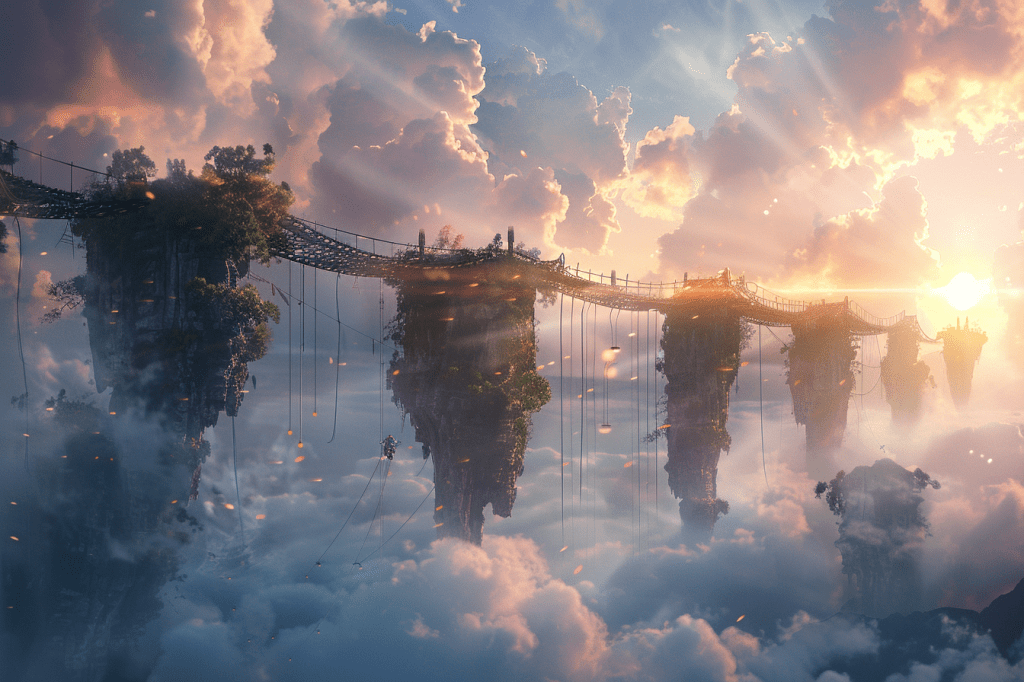
Floating stone islands connected by rope bridges hang suspended in a glowing sky above the clouds, evoking a sense of magic, distance, and longing.
This is the world that still hums in the back of my mind… untethered, alive, and waiting. Generated by Midjourney

But I can see that it might not be trending right now. So I’ve been wondering… should I shelve it and try to develop something trend friendly? Something that better aligns with current book publishing trends or what’s hot on BookTok?

The thing is, the trend friendly story I’m eyeing? I genuinely love it too. It’s not just a shallow attempt to chase what’s hot, it’s been simmering in my brain for years, just waiting for its moment.

I won’t give away too much (yet), but it involves a woman grappling with a life she didn’t ask for, powers she doesn’t want, and a world that suddenly won’t leave her alone. There’s danger, heartache, and one very sarcastic cat who heckles her with the same intensity my cat Carmen reserves for whatever food I’m currently trying to eat. This one just happens to tick more of the boxes traditional publishing is looking for right now, especially if you’re writing with the market in mind.

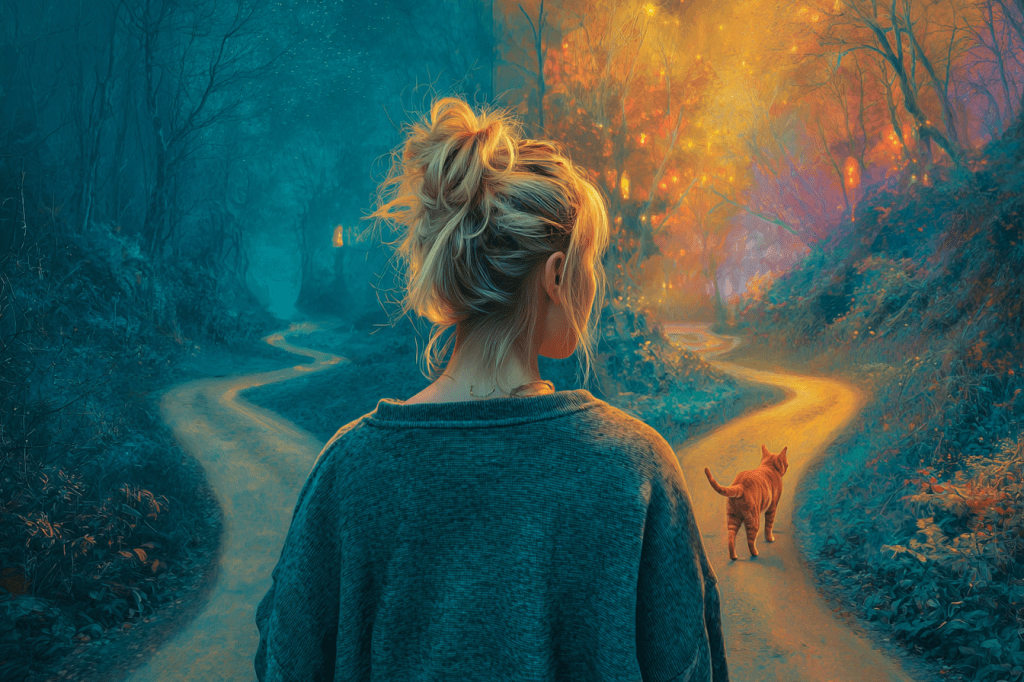
A woman with messy blonde hair stands at a fork in a forest path. One side is dark and shadowy, the other glows with warm magical light. A ginger cat walks ahead toward the glowing path.
Standing at the crossroads between heart and hustle. The cat, of course, already knows which way to go. Generated by Midjourney

So what do we do?

Do we write what sells? Do we write to market to improve our chances of getting published? Or do we write what sings?

Is it possible to do both?

Maybe there’s a hybrid path. Maybe we shape a passion project just a little more toward trend. Or we self publish what we love and query the marketable one. Maybe the trick is figuring out which story needs to be told right now, and which one can wait for its moment.

This post isn’t me giving you answers. It’s me asking questions. Honest ones. Because I think a lot of us are stuck here, especially those of us trying to navigate the publishing industry.

I want to know what you think.

Have you ever paused a beloved project because it wasn’t “sellable”? Or shelved something that felt like screaming into the void? Have you followed the market and found success or regret?

Are you team write-what-you-love, team write-to-sell, or somewhere tangled in between?

Drop your thoughts in the comments. Let’s talk about it.

Fixing Plot Holes in Fantasy Writing (with Help From the Next Generation)

I was elbows deep in Wind Riders fantasy worldbuilding, notes everywhere, cats prowling, tea long forgotten, when my daughter wandered in and casually asked, “What are you working on?”

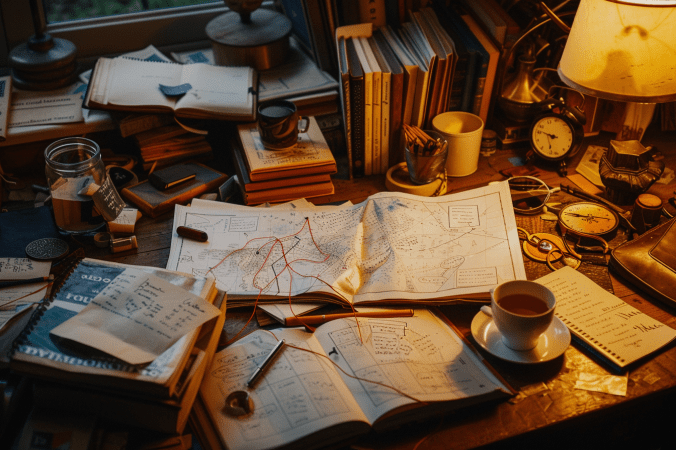
A cluttered writer’s desk filled with open notebooks, fantasy maps marked with red string, scribbled notes, scattered books, and a cup of tea under a warm lamp. The scene evokes cozy chaos and deep worldbuilding focus.
Where the chaos begins… notes, tea, and the occasional cat. (Image created by Midjourney)

What followed was a two-hour lore-dump-turned-interrogation that felt like a surprise writing sprint disguised as a conversation. Nyx the cat was displaced so she could take a seat (and gave us both the look of betrayal only a black cat can muster, complete with a drawn out whine of protest. Poor baby.), but the moment she sat down and started asking questions, something clicked… and kept clicking.

We talked through the Cataclysm, the rise of the Riders, the floating islands, and the process of fixing plot holes and developing stronger character arcs, bringing life to story ideas that had been gathering dust. The next thing we knew, two hours had passed. By the time we looked up, we’d unraveled the antagonist arc, reshaped a love interest dynamic, and, somehow, figured out how the first book ends.

I’m not going to tell you that part. Not yet. But I will say that somewhere between her raised eyebrow and my rambling, I realized something big: this isn’t a standalone story.

It’s a trilogy.

What started as a standalone suddenly stretched its wings. There were too many threads, too much heart, to wrap in one book. And somehow, that made it all feel more real.

You know that feeling when a puzzle piece slots in and suddenly the whole picture shifts into focus? That. It reminded me how powerful it is to talk things out with someone who isn’t inside your head. I’ve always been a worldbuilding-first kind of writer (you can read more about that here), but getting outside input shook loose some things I didn’t even realize were stuck. Bouncing ideas off someone who isn’t emotionally attached to that one scene you refuse to cut, or the backstory you secretly wrote five pages for? Invaluable.

A whimsical sky town perched on a large floating island above the clouds. Wooden bridges, windmills, lanterns, and rustic buildings glow in soft golden light as birds soar across the sky.
The kind of place my Wind Riders would call home… lanterns, walkways, and just enough altitude to make things interesting. (Image created by Midjourney)

And when that someone gets into it too? Starts pitching scenes back at you like a pro? It’s like biting into a story filled bonbon, surprising, rich, and just the right kind of sweet.

So yes, I got grilled today. Lovingly. And the result is a better story, a clearer arc, and a brain that’s buzzing with the kind of excitement that only comes from brainstorming a fantasy trilogy that finally works.

(Nyx remains unimpressed. I owe her a treat. Worth it.)

Worldbuilding: A Cautionary Tale in Too Many Tabs

Worldbuilding starts innocently enough. You name a kingdom. Maybe draw a map. Maybe throw in a couple of gods, a weird storm, a family tree with just enough trauma to be narratively satisfying.

A cozy, cluttered writer’s desk bathed in soft light. A black cat lounges across hand-drawn fantasy maps and scattered notes. A pink teacup sits nearby, surrounded by vintage books, wildflowers, and the charming chaos of worldbuilding.
Nyx, in her natural habitat: guarding the map she will never let you finish. Somewhere under that paw is a vital plot point. We’ll never know. Image created by Midjourney.

Then one day you blink and realize you’ve written a 3,000 word document on sky island crop rotation. You can’t remember your own birthday, but you know which fictional provinces export fermented windfruit and why their trade alliance fell apart in Cycle 617.

This post? It’s a love letter. And a warning.

People think you have to know everything before you start, but if you did, we’d all be frozen in “research” mode until the sun exploded. It doesn’t need to be logical either, it just needs to feel true to your world. And no, it’s not just for fantasy authors. If you made up a cozy town with suspiciously nosy neighbors and a bakery that mysteriously never runs out of raspberry scones… congratulations, you’re one of us.

Worldbuilding is part chaos magic, part archaeology. You’re not building a world, you’re excavating one you barely understand, with a pen instead of a shovel and caffeine instead of common sense.

It’s balancing six cultural systems, a magic rule you regret inventing, and a civil war you vaguely alluded to in chapter two that now demands three pages of backstory and a hand drawn battle map.

It’s naming things like a drunk linguist. It’s opening your notebook and realizing you’ve contradicted your own timeline in three different places and somehow invented a holiday that happens every thirteen days.
It’s divine, maddening, and wildly inefficient.

And sometimes… it’s dangerous.

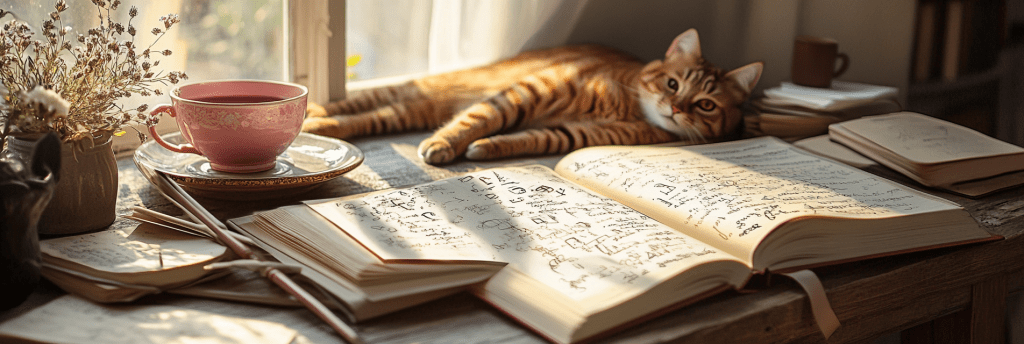
A cozy cottagecore writing desk in warm, natural light. A long orange cat sprawls across open notebooks filled with fictional alphabets and scribbled translations. A tipped pink teacup stains scattered parchment, while quills, ink smudges, and wildflowers complete the scene of whimsical worldbuilding chaos.
Finnegan, master of stretching, spilling tea, and rewriting your language system with one well-timed flop. Chaos is his comfort zone. Image created by Midjourney.


Because once the worldbuilding black hole opens up, it sucks you in. Suddenly it’s 2 a.m., your eyes are dry, your tea is cold, and the story you meant to write has been sitting untouched like a gentleman caller you stood up on the porch, in the rain, with flowers. And bless it, the poor thing’s still waiting for you.

But despite all that, there’s this moment, if you’re lucky, when you zoom out and realize it all fits together. Like the world was waiting for you to stumble onto it. When a reader points out a connection between two pieces of lore and you’re like, Yes, I did that on purpose absolutely I am a genius.

Or when a character walks into a room and you know what’s on the walls, what year it was built, who buried a secret in the floorboards, and why the ceiling still leaks. I may not use everything I know in that moment, but in the future, who knows?

It’s tea-stained madness with a side of purpose.

Maybe it’s punishment. Maybe it’s passion.

Probably both.

Because let’s be honest, I don’t worldbuild because I have to. I worldbuild because I can’t not. I’m already asking “what if” a hundred times a day. I might as well write it down and charge my protagonists emotional interest.

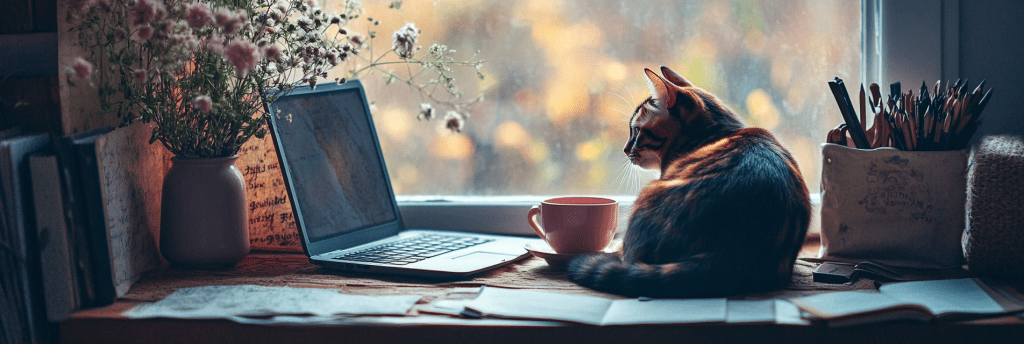
A cozy writer’s desk in warm ambient light. A tortoiseshell cat sits curled atop an open laptop beside a pink teacup, gazing thoughtfully out the window. Scattered notes, wildflowers in a vase, and a container of pens and quills complete the soft, creative chaos.
Carmen, as she exists in spirit and judgment. Image created with Midjourney.

Also? It’s fun. Fungi-powered cities? Sentient storms? An economy based on literal hot air? I’m not just building a world, I’m raising it like a feral child I fully intend to unleash on readers.

What’s the weirdest rabbit hole you’ve fallen into while worldbuilding? Calendar math? Magical sewage systems? A military hierarchy based on fish?

Tell me in the comments. Validate me. Share the pain. Maybe bring snacks.

And stay tuned, I’ll be opening the doors to some of my multiversal chaos soon in a section called My Worlds, where you can marvel (or panic) at the sheer number of universes I’m juggling like a gremlin with a tea addiction.

Because why write one world… when you can write twelve?

Behind the Fog: Writing, Wind Riders, and Eye Strain

Hey everyone! Welcome to my cozy little corner of the internet where I’ll be sharing my writing adventures, musings, and maybe enjoying a few virtual chai lattes along the way.

A cozy, softly lit writing desk covered in open fantasy maps, aged notebooks, and a pink teacup steaming gently. A dark pawprint marks one of the map pages, hinting at feline interference in the midst of worldbuilding.

Lately, I’ve been happily hiding away from the chaos of the world by immersing myself in the Wind Riders universe. There’s something magical about escaping into a world of sky islands, Wind Riders, and airborne adventures that makes reality feel a little less daunting. One of the best parts of world building is when you stumble on those hidden gems beneath the clouds that make you blink and think, “Why didn’t I think of that before?” It’s all part of the fun and games of creating new worlds.

In the process of dreaming up new things for the Wind Riders, I’ve somehow managed to give myself a bit of eyestrain. A thousand words later, I find myself with a headache and the will to go on, but my body is definitely not on the same page.

I’ve got a bunch of short stories in mind for the Wind Riders series, and I’m also outlining two novels: one exploring the origins of the Wind Riders and another set in their future, full of new adventures and discoveries. So, there’s plenty of excitement on the horizon!

I’ll dive back into it once the aches and pains subside and I can wrap my brain around all these ideas again. Until then, I’ll be resting up and dreaming of sky islands and adventures to come!