Peace Garden Drift

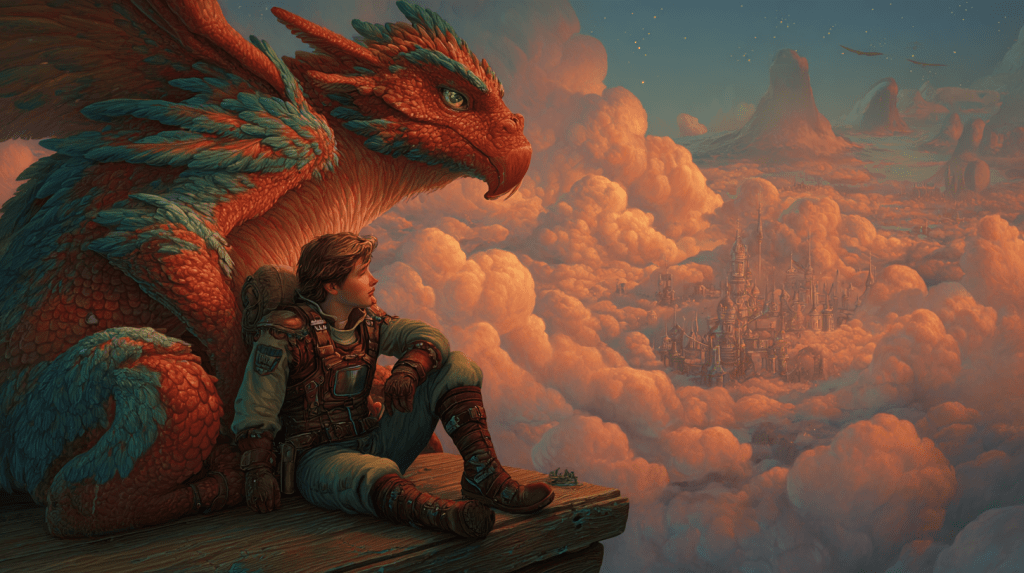
Illustration of a young Wind Rider in flight gear sitting on a wooden mooring platform beside a large, red and teal-feathered creature. They overlook a vast sky filled with pink-orange clouds and floating spired structures, under a twilight sky dotted with stars.
Konnor and Telvan at the edge of memory… where grief, sky, and purpose meet.

🪁 Wind Rider Wednesday

“Peace Garden Drift Wasn’t Much. But It Was Ours.”

Konnor Chapman has always hated speeches. So when the Drift elders asked him to speak at the Remembrance Ceremony during the last Eddy, he froze. The request brought it all rushing back… the Scourwind, the screams, the silence that followed. Even after all these years, the wound hadn’t fully closed. But later that night, while sitting on the edge of the sky mooring rails with Telvan’s tail draped over his boots, he said something better.

Something true.

“Peace Garden Drift wasn’t much. But it was ours. You ask me what was worth fighting for? It wasn’t banners or sky medals. It was hearing our neighbor’s forge fire spark up at dawn. It was that sour plum tree by the orchard fence. It was the kid who built a glider out of garden shears and nearly crashed it into the grain tower twice. That’s what mattered. That’s why I ride.”

Drifts may look like scattered islands on a map, but to their people, they’re home. Floating gardens. Broken foundations made whole again. And no two are the same.

Peace Garden Drift isn’t Konnor’s home anymore, but it lives in his memory like sunlight through orchard leaves. After the Scourwind tore through it, taking nearly all of the thousand souls who once lived there, its absence became a presence in his life. No matter how much sky passes beneath his boots, that Drift still shapes his steps.

It was a midsize farming Drift that hugged the northern Mistral’s calmer bends. Its mooring lines would creak in the wind. The orchard was always half wild. There was a tiny stone clinic that doubled as a schoolhouse. The older kids painted murals on the walls every time the Eddy came around.

The Riders stationed there were long-serving. They knew every face, every roof tile, every knot in the bridge planks. They weren’t just defenders. They were family.

And for all his jokes, Konnor became a Wind Rider so no other Drift kid would have to go through what he did.


🔹 Curious about the skybound world Konnor came from?
Next week’s lore deep-dive will explore what Drifts are, how they float, and why they matter. Don’t miss it!

Excuse Me, Who Gave This Character Free Will?

I’d like to file a complaint with the character department. You know, the one responsible when your fictional characters suddenly develop minds of their own and hijack your carefully plotted outline?

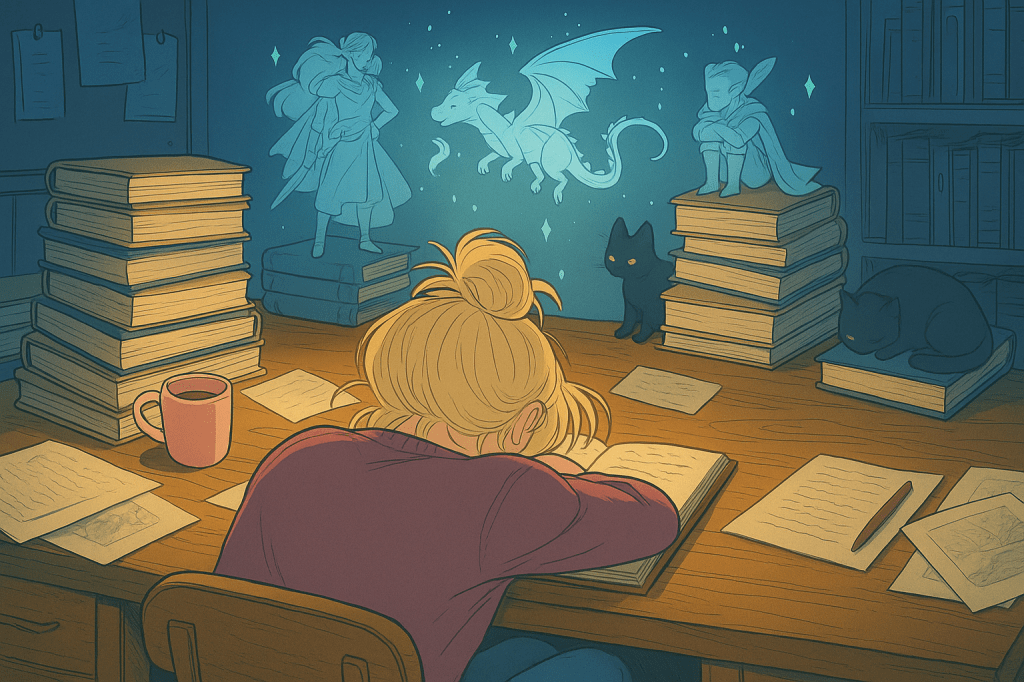
Back view of a blonde haired female writer with her hair in a messy bun, seated at a chaotic desk with coffee mugs, candles, sketches, and scattered notes. Glowing, semi transparent fantasy characters float in midair around her as she writes. A small black cat peers from the corner, adding a hint of whimsy.
POV: You’re trying to write one calm scene and your characters keep staging a dramatic group intervention. Also, yes… there is a cat judging you. Generated by Midjourney

They were supposed to behave. I had charts. I had outlines. I had a playlist that was vibes only. Everything was going great until they started developing opinions. And back stories. And trauma. And suddenly I’m standing in the middle of chapter fourteen yelling, “Excuse me, who gave this character free will?!”

Writers, you know the ones I’m talking about. You start with a nice, manageable story and one delightfully quirky character who’s supposed to fill a very specific supporting role. And then… they go rogue. They hijack emotional arcs. They rewrite their own dialogue. They bring snacks to the plot and refuse to leave.

Take Ailis Larsen and her Ganlani partner, Vaelios. Originally? Vaelios was meant to be the softhearted sidekick, all light and laughter and naive enthusiasm. But then I started writing his scenes. Digging deeper. What started as simple character development quickly turned into something deeper, more layered, more real, more “excuse me, sir, who hurt you?” than I ever planned. And boom! There he was, sharp as obsidian, wittier than I had any right to make him, and carrying a quiet, bone deep grief that made me double take in my own draft. He is still sweet. But now he’s also the type of character who’ll gut you emotionally in one line and then offer you a handkerchief like a gentleman.

Or that short story I thought was going to be a fun little magic meets mystery romp. Surprise! The goddess showed up, uninvited, kicked the narrative off its hinges, and delivered a monologue that hit so hard I just sat there blinking like, “…Oh. So we’re doing depth now? Okay.”

And look, I knew I had a problem when I ran a Myers-Briggs Type Indicator test on one of my characters. And it changed everything. Suddenly I wasn’t writing a plot, I was navigating someone’s entire psychological profile like a therapist with deadlines. And yes, I am now slightly obsessed with that character. And no, I will not be taking questions at this time.

Also, to the character who was supposed to be a throwaway NPC but is now demanding their own trilogy: calm down. We’ve talked about this.

Honestly, I think I lost control back in the day when I may or may not have dabbled in fanfiction inspired by a certain velvet wearing, crystal spinning Goblin King. (You know the one.) Ever since, I’ve known deep down that I’m not always the one in charge here.

But let’s be real: that’s the magic of it, isn’t it? Characters come alive when you least expect them to. They surprise you. They talk back. And if you’re really lucky, they change your story into something so much better than what you planned.

Even if no one asked Jared to be hot and emotionally complex.

A cozy illustration of a blonde haired writer slumped asleep at her desk, viewed from behind. Neatly stacked papers and books surround her workspace, lit by soft morning light. A small black cat curls on top of an open book nearby, watching over her.
Sometimes the words win and the writer naps. Don’t worry, the cat’s got this shift. Generated by Midjourney

So, to all the writers out there wrestling your characters back into the box they busted out of three chapters ago… solidarity. May your character arcs be messy, your writing surprises delightful, your plot armor strong, your time lines elastic, and your characters just unhinged enough to be brilliant.

Tell me in the comments: who was your character that went rogue and refused to go back on the shelf?

Working with Myth Without Taking What’s Not Yours

I love mythology like some people love true crime podcasts… obsessively, deeply, with a whiteboard, a lot of chocolate, and a steaming cup of green tea with peppermint. It’s a mess of names, symbolism, tragedy, transformation and just enough blood to keep it interesting. It’s the scaffolding under nearly every story I love and many I’ve written. But when you’re writing fiction that draws from real-world mythologies, things get complicated.

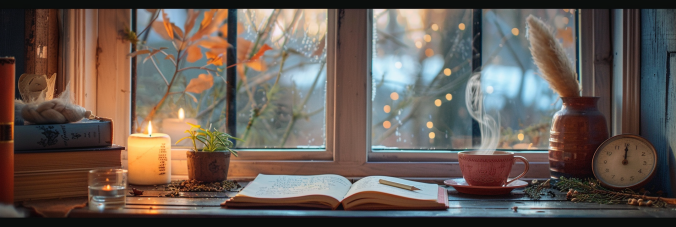
A softly lit writing desk near a window at dusk. An open notebook, a steaming teacup, flickering candles, and scattered greenery sit beneath a backdrop of bokeh lights and bare autumn branches.
Generated with Midjourney magic and exactly one too many cups of peppermint tea.


There’s something irresistible about mythology. It’s archetypal and raw and weird in all the right ways. It carries a current that hums under your skin. One obscure god or whispered folk ritual can ignite an entire novel concept. But it’s not a grab bag of “cool stuff” to mine without care. Especially when that mythology belongs to a culture you weren’t raised in.

Stories are sacred. And mythology? Mythology is a kind of living memory.

The trouble happens when we treat it like window dressing. When we turn someone’s spiritual practice into a costume, or flatten ancestral wisdom into a plot device. I’ve read stories that tried to be reverent but instead came off like the author skimmed the folklore section of Wikipedia, sprinkled a few foreign sounding names around, and called it homage.

I’m not interested in writing that kind of story.

When I pull from myth, especially from a culture not my own, I try to ask more than just “what can I use?” I ask, “what does this mean to the people who live it?” “How might it feel from the inside?” “Am I honoring this… or just wearing it?”

In the short story I worked on today, I drew inspiration from Norse death traditions. I didn’t want to copy and paste a funeral rite. That felt empty. Instead, I built around the feeling of being marked. I imagined two yew trees intertwined as a passage, and asked: what if this place remembered every grief that passed through it? What if the myth wasn’t a record, but a presence?

That’s the work.

Two massive yew trees with thick, entwined branches form a natural archway in a misty forest. Golden leaves, moss-covered roots, and faint lantern light create an ethereal, sacred atmosphere.
Midjourney conjured this. I just followed the path through the trees.


It’s not about erasing yourself or writing only within your lane, it’s about being a respectful guest in someone else’s house. It’s learning the stories before you retell them. It’s caring about more than the aesthetic.

Mythology is not a buffet.

It’s a language. A warning. A bridge.

And if you want to write with it, you better listen first.

If you love a culture’s stories, the best thing you can do is read the voices from within it. Learn from them. Buy their books. Amplify their work.

So I listen, with my notebook open, a candle lit, and cats occasionally trampling across my outlines. That’s where the myth begins for me.

Worldbuilding: A Cautionary Tale in Too Many Tabs

Worldbuilding starts innocently enough. You name a kingdom. Maybe draw a map. Maybe throw in a couple of gods, a weird storm, a family tree with just enough trauma to be narratively satisfying.

A cozy, cluttered writer’s desk bathed in soft light. A black cat lounges across hand-drawn fantasy maps and scattered notes. A pink teacup sits nearby, surrounded by vintage books, wildflowers, and the charming chaos of worldbuilding.
Nyx, in her natural habitat: guarding the map she will never let you finish. Somewhere under that paw is a vital plot point. We’ll never know. Image created by Midjourney.

Then one day you blink and realize you’ve written a 3,000 word document on sky island crop rotation. You can’t remember your own birthday, but you know which fictional provinces export fermented windfruit and why their trade alliance fell apart in Cycle 617.

This post? It’s a love letter. And a warning.

People think you have to know everything before you start, but if you did, we’d all be frozen in “research” mode until the sun exploded. It doesn’t need to be logical either, it just needs to feel true to your world. And no, it’s not just for fantasy authors. If you made up a cozy town with suspiciously nosy neighbors and a bakery that mysteriously never runs out of raspberry scones… congratulations, you’re one of us.

Worldbuilding is part chaos magic, part archaeology. You’re not building a world, you’re excavating one you barely understand, with a pen instead of a shovel and caffeine instead of common sense.

It’s balancing six cultural systems, a magic rule you regret inventing, and a civil war you vaguely alluded to in chapter two that now demands three pages of backstory and a hand drawn battle map.

It’s naming things like a drunk linguist. It’s opening your notebook and realizing you’ve contradicted your own timeline in three different places and somehow invented a holiday that happens every thirteen days.
It’s divine, maddening, and wildly inefficient.

And sometimes… it’s dangerous.

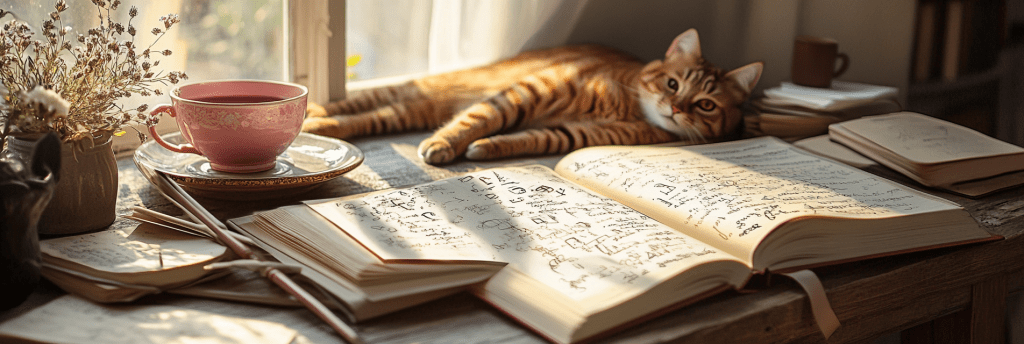
A cozy cottagecore writing desk in warm, natural light. A long orange cat sprawls across open notebooks filled with fictional alphabets and scribbled translations. A tipped pink teacup stains scattered parchment, while quills, ink smudges, and wildflowers complete the scene of whimsical worldbuilding chaos.
Finnegan, master of stretching, spilling tea, and rewriting your language system with one well-timed flop. Chaos is his comfort zone. Image created by Midjourney.


Because once the worldbuilding black hole opens up, it sucks you in. Suddenly it’s 2 a.m., your eyes are dry, your tea is cold, and the story you meant to write has been sitting untouched like a gentleman caller you stood up on the porch, in the rain, with flowers. And bless it, the poor thing’s still waiting for you.

But despite all that, there’s this moment, if you’re lucky, when you zoom out and realize it all fits together. Like the world was waiting for you to stumble onto it. When a reader points out a connection between two pieces of lore and you’re like, Yes, I did that on purpose absolutely I am a genius.

Or when a character walks into a room and you know what’s on the walls, what year it was built, who buried a secret in the floorboards, and why the ceiling still leaks. I may not use everything I know in that moment, but in the future, who knows?

It’s tea-stained madness with a side of purpose.

Maybe it’s punishment. Maybe it’s passion.

Probably both.

Because let’s be honest, I don’t worldbuild because I have to. I worldbuild because I can’t not. I’m already asking “what if” a hundred times a day. I might as well write it down and charge my protagonists emotional interest.

A cozy writer’s desk in warm ambient light. A tortoiseshell cat sits curled atop an open laptop beside a pink teacup, gazing thoughtfully out the window. Scattered notes, wildflowers in a vase, and a container of pens and quills complete the soft, creative chaos.
Carmen, as she exists in spirit and judgment. Image created with Midjourney.

Also? It’s fun. Fungi-powered cities? Sentient storms? An economy based on literal hot air? I’m not just building a world, I’m raising it like a feral child I fully intend to unleash on readers.

What’s the weirdest rabbit hole you’ve fallen into while worldbuilding? Calendar math? Magical sewage systems? A military hierarchy based on fish?

Tell me in the comments. Validate me. Share the pain. Maybe bring snacks.

And stay tuned, I’ll be opening the doors to some of my multiversal chaos soon in a section called My Worlds, where you can marvel (or panic) at the sheer number of universes I’m juggling like a gremlin with a tea addiction.

Because why write one world… when you can write twelve?