When the Muse Shows Up at the Worst Time (and You Let Her Anyway)

Back view of a female writer at night, seated at a cluttered desk under warm lamplight and glowing string lights, surrounded by open books, scattered papers, and a rainy window
When inspiration strikes at 2AM, you light a candle, grab a pen, and let the chaos spill onto the page.

There I am, brushing my teeth, winding down for the night, and suddenly… BOOM. The Muse shows up. Not with a gentle knock, but with a full-blown marching band of inspiration, complete with jazz hands and fully formed plot twists. Of course, it’s late. Of course, I’m half asleep. And of course, when I wake up in the morning? Poof. Gone. Like a dream you swore you’d remember, but now you’re standing in the kitchen yelling “Nooo!” at your coffee because all that’s left is a ghost of an idea and maybe a few jumbled words like “mirror sword” or “cat uprising.”

I’ve tried dictating into my phone. Once, I actually managed to get an idea down that way, only for a system update to sweep in and delete it into the digital abyss. Thanks, technology. Not to mention, I feel absolutely ridiculous whispering fantasy dialogue to my phone like some sort of bedtime bard, and my poor husband really doesn’t appreciate being woken up by my late night monologues.

Curly-haired blonde woman in pink striped pajamas writing in a notebook while sitting cross-legged on a toilet, toothbrush in mouth, as a wide-eyed black cat watches glowing inspiration stars swirl above
When the muse doesn’t care that it’s 3AM and you’re mid-toothbrush… Carmen supervises anyway.

Back in my commuting days, the muse would hijack my brain while I was stuck in traffic or squished between strangers on the bus. At least then I could jot things down into the notes app, one-handed, with a bagel in the other. These days, working from home means I can keep my laptop open and toss ideas into a doc as they hit. But I definitely don’t do it in front of company. I do have some dignity left, thank you very much.

The absolute worst is when I’m watching something brilliant, like a movie or a play, and my story brain lights up while I sit there unable to take notes. I sit there, vibrating with potential, praying I’ll remember it later. (Spoiler: I usually don’t.)

Before smartphones, I was part of the huge-purse crew and always had a notepad and pen with me. I’ve scribbled ideas on the backs of receipts, on envelopes, once even on a clean-ish napkin during lunch. Desperate times. Inspired minds.

And yes, I try to forgive myself when the idea slips through my fingers. It’s hard. I have to believe it’ll come back. Maybe stronger. Maybe clearer. Maybe not at 2AM this time. The more I chase it, the faster it vanishes, like when you’re trying to remember a word that’s just out of reach. So instead, I try to let it go. And trust that if it mattered, it’ll find me again.
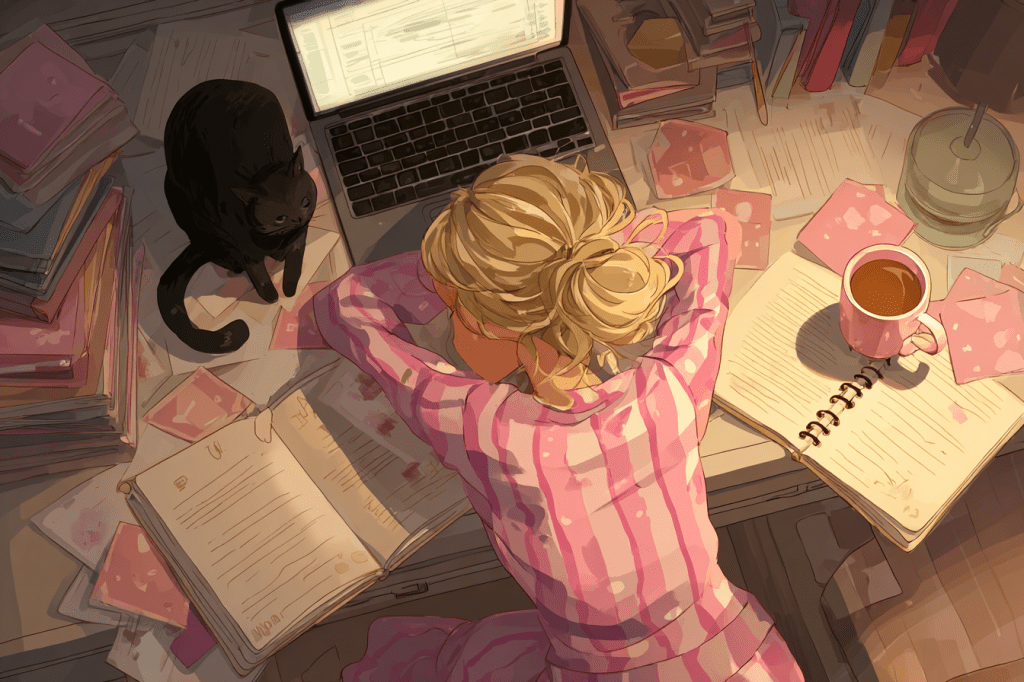
Blonde woman in pink striped pajamas asleep at a cluttered writing desk, head resting on folded arms beside a black cat, open books, a laptop, and a pink coffee mug
Sometimes the muse wins, sometimes exhaustion does. Either way, the cat’s judging you.

Honestly, the Muse is a lot like a skittish puppy. One second she’s climbing all over you with chaotic excitement, the next she’s under the couch refusing to come out. Patience, snacks, and the occasional sacrifice of a quiet evening are usually the best ways to coax her back.

So if you’re out there muttering plot lines into your shampoo bottle or scribbling dialogue on old receipts, you’re not alone. Welcome to the club. We meet at 3AM. Snacks are optional but strongly encouraged.
The Modern Author’s Marketing Maze

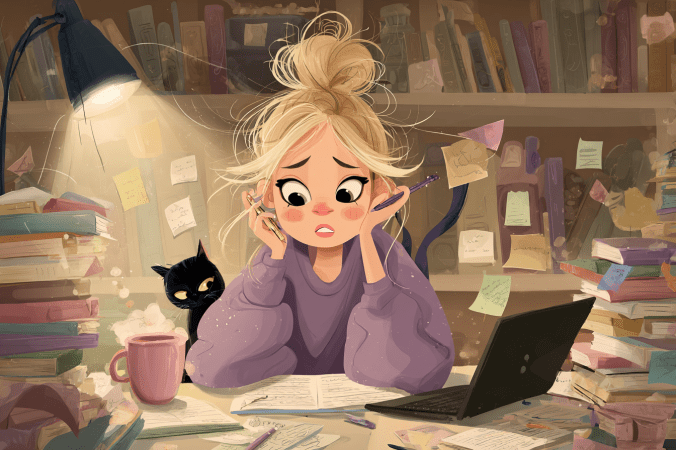
Frazzled blonde author in messy bun multitasking at cluttered desk with laptop, black cat, coffee mug, and scattered notes, looking overwhelmed while working late.
When your “writing day” turns into a full-time job juggling social media, newsletters, and that cursed algorithm.

These days, writing the book almost feels like the easy part. Typing “The End” isn’t the finish line. It’s the starting gun for a whole new race. Because if you want people to actually read your story instead of letting it collect digital dust, you’re not just an author anymore. You’re a full blown one person marketing department. Congrats! You’re now the writer, publicist, designer, spokesperson, and hype squad. Hope you brought snacks.

Let’s break down what that glorious chaos looks like.

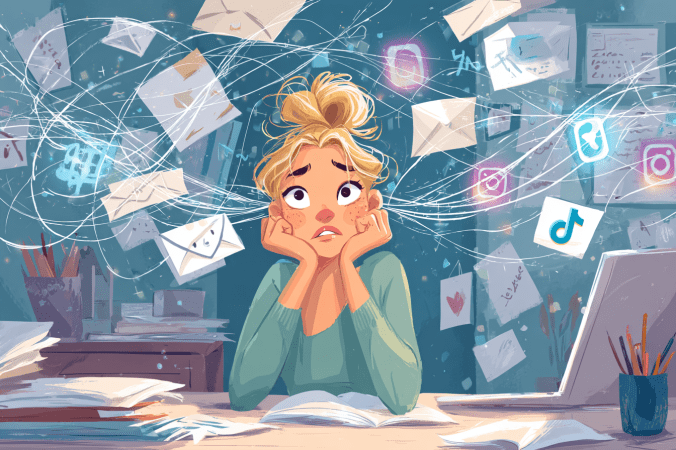
Overwhelmed blonde writer at desk surrounded by flying social media icons, emails, and notifications, symbolizing digital burnout and author marketing pressure.
When your book’s not even out yet but you’ve already lost three hours to hashtags, inbox pings, and dancing TikToks you might have to recreate.

You need a website that doesn’t look like it crawled out of a 2010 WordPress graveyard. You need a newsletter, because apparently we’re back in 2003 and emails are trendy again. You need to exist on multiple social platforms because nobody agrees on where readers live anymore. TikTok? Threads? Bluesky? Instagram? X? You better be witty, wise, and worth following everywhere. Oh, and you also need to be a video editor, a graphic designer, a community manager, and someone who replies to comments like you’ve got unlimited spoons and an eternal serotonin supply.

And let’s not forget in person events. I’ve been to a few. Sometimes they’re lively and inspiring. Other times, you see authors behind tables with piles of their books and hopeful eyes, trying to smile while strangers awkwardly avoid eye contact. It’s like high school lunch tables all over again, only with more bookmarks. Even book launches, once glamorous milestones, are now DIY marathons. You’re expected to plan the whole thing yourself: giveaways, digital countdowns, themed merch, launch parties. Maybe even a dancing reel if you’re brave enough.

Confident blonde female author sitting at a book fair table, surrounded by stacks of books and smiling at the bustling crowd around her.
Fake it till you make it? More like smile till your face hurts and hope someone asks about your book before the coffee wears off.


Then there’s the dreaded algorithm. A fickle deity who doesn’t care how good your book is or how many nights you cried into your tea over it. It only wants to know: Did you post at peak engagement time while reciting a trending audio and juggling hashtags like a circus act? No? Good luck, sweetheart.

Honestly, it’s a lot. It’s so much. Most of us didn’t get into writing to become online personalities or content creators. We just wanted to tell stories. Not become social media strategists.

So to every author out there showing up anyway, learning one post at a time, facing awkward silences at signings, crafting graphics at midnight, or smiling through the fear—I see you. I admire the hell out of you.

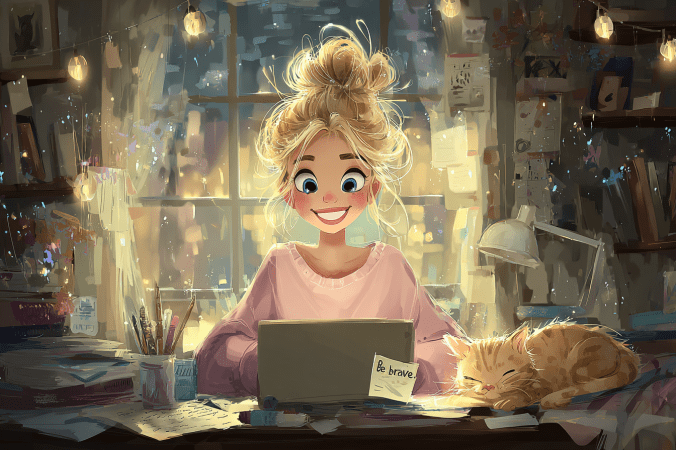
Smiling female writer at her laptop in a cozy, warmly lit room with a sleeping orange cat beside her and a sticky note that says “Be brave.”
This is the goal, right? A quiet moment of joy, a brave heart, and just enough cat hair in the keyboard to prove you’re living the writer’s dream.

And when it’s my turn, I hope I can be just as brave. Because up until now, I’ve only put short stories out into the world. The thought of marketing a whole book? Yeah… it scares the absolute hell out of me.

Daily Prompt 24 06 2025

Daily writing prompt
How important is spirituality in your life?

Let’s just say Mother Nature and I are on excellent terms. 🌿 I’m a quiet little pagan bean who follows the rhythm of the seasons and honors the goddess in her many forms. It’s not something I shout from the rooftops (unless it’s Beltane, then all bets are off), but it’s deeply personal and sacred to me. I believe in respecting all things, people, plants, planets, and I expect that same respect in return. My spirituality keeps me grounded, especially when the world feels like a hot mess express. So yes, it’s important. Hugely. Just… whispered, not broadcasted.

Excuse Me, Who Gave This Character Free Will?

I’d like to file a complaint with the character department. You know, the one responsible when your fictional characters suddenly develop minds of their own and hijack your carefully plotted outline?

Back view of a blonde haired female writer with her hair in a messy bun, seated at a chaotic desk with coffee mugs, candles, sketches, and scattered notes. Glowing, semi transparent fantasy characters float in midair around her as she writes. A small black cat peers from the corner, adding a hint of whimsy.
POV: You’re trying to write one calm scene and your characters keep staging a dramatic group intervention. Also, yes… there is a cat judging you. Generated by Midjourney

They were supposed to behave. I had charts. I had outlines. I had a playlist that was vibes only. Everything was going great until they started developing opinions. And back stories. And trauma. And suddenly I’m standing in the middle of chapter fourteen yelling, “Excuse me, who gave this character free will?!”

Writers, you know the ones I’m talking about. You start with a nice, manageable story and one delightfully quirky character who’s supposed to fill a very specific supporting role. And then… they go rogue. They hijack emotional arcs. They rewrite their own dialogue. They bring snacks to the plot and refuse to leave.

Take Ailis Larsen and her Ganlani partner, Vaelios. Originally? Vaelios was meant to be the softhearted sidekick, all light and laughter and naive enthusiasm. But then I started writing his scenes. Digging deeper. What started as simple character development quickly turned into something deeper, more layered, more real, more “excuse me, sir, who hurt you?” than I ever planned. And boom! There he was, sharp as obsidian, wittier than I had any right to make him, and carrying a quiet, bone deep grief that made me double take in my own draft. He is still sweet. But now he’s also the type of character who’ll gut you emotionally in one line and then offer you a handkerchief like a gentleman.

Or that short story I thought was going to be a fun little magic meets mystery romp. Surprise! The goddess showed up, uninvited, kicked the narrative off its hinges, and delivered a monologue that hit so hard I just sat there blinking like, “…Oh. So we’re doing depth now? Okay.”

And look, I knew I had a problem when I ran a Myers-Briggs Type Indicator test on one of my characters. And it changed everything. Suddenly I wasn’t writing a plot, I was navigating someone’s entire psychological profile like a therapist with deadlines. And yes, I am now slightly obsessed with that character. And no, I will not be taking questions at this time.

Also, to the character who was supposed to be a throwaway NPC but is now demanding their own trilogy: calm down. We’ve talked about this.

Honestly, I think I lost control back in the day when I may or may not have dabbled in fanfiction inspired by a certain velvet wearing, crystal spinning Goblin King. (You know the one.) Ever since, I’ve known deep down that I’m not always the one in charge here.

But let’s be real: that’s the magic of it, isn’t it? Characters come alive when you least expect them to. They surprise you. They talk back. And if you’re really lucky, they change your story into something so much better than what you planned.

Even if no one asked Jared to be hot and emotionally complex.

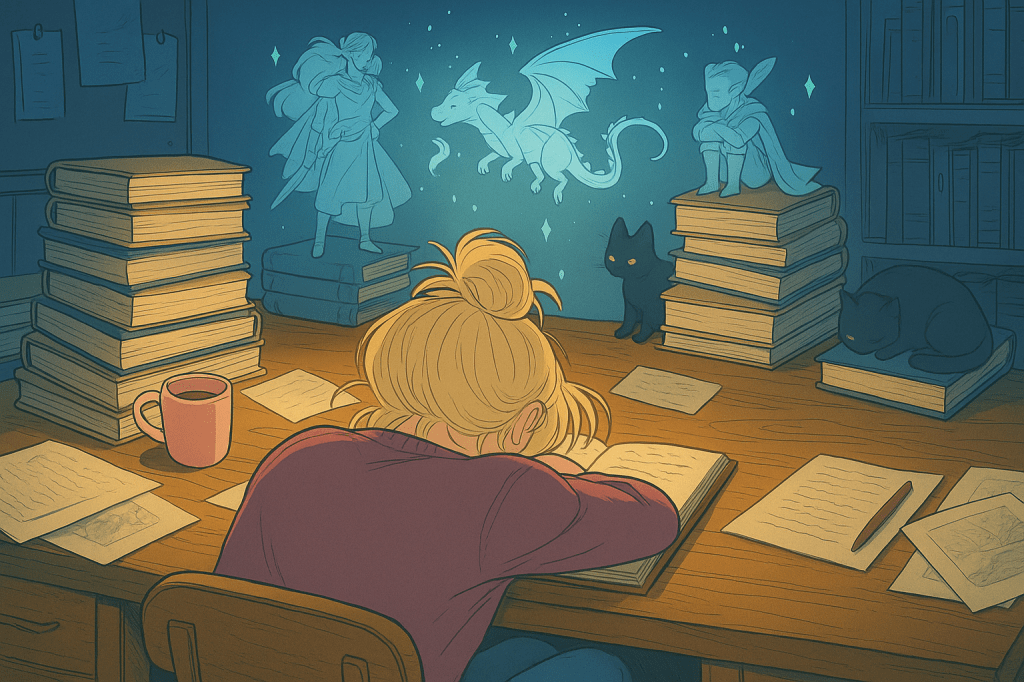
A cozy illustration of a blonde haired writer slumped asleep at her desk, viewed from behind. Neatly stacked papers and books surround her workspace, lit by soft morning light. A small black cat curls on top of an open book nearby, watching over her.
Sometimes the words win and the writer naps. Don’t worry, the cat’s got this shift. Generated by Midjourney

So, to all the writers out there wrestling your characters back into the box they busted out of three chapters ago… solidarity. May your character arcs be messy, your writing surprises delightful, your plot armor strong, your time lines elastic, and your characters just unhinged enough to be brilliant.

Tell me in the comments: who was your character that went rogue and refused to go back on the shelf?

Mental Health and the Writer’s Block No One Talks About

Some days, writing feels like breathing. Other days, it feels like climbing out of a pillow fort lined with existential dread.

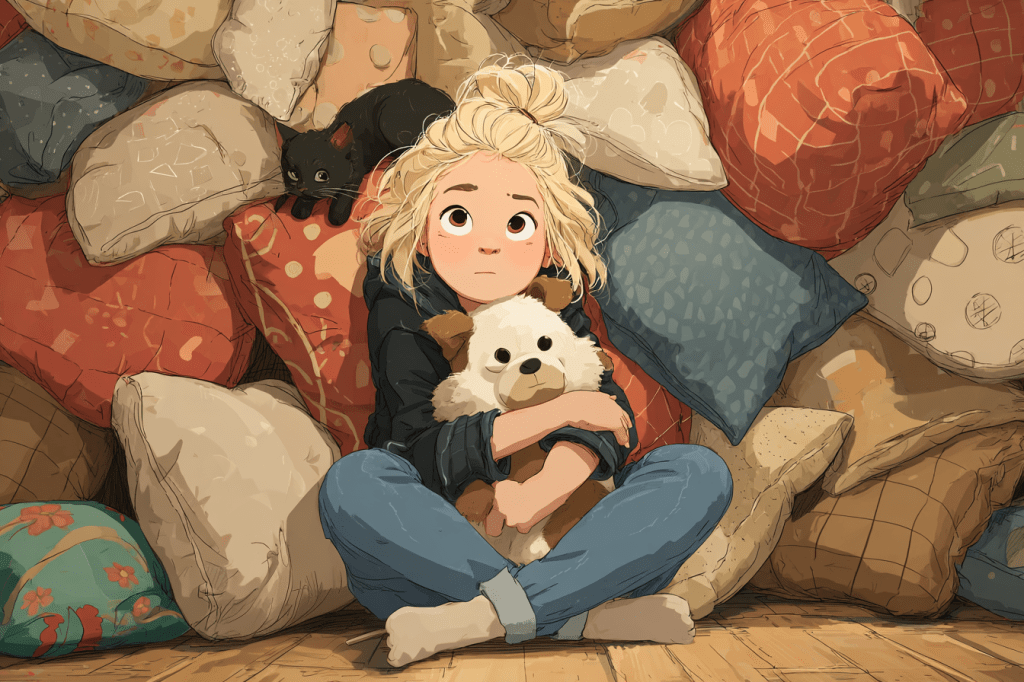
A young blonde girl sits curled up in a large pillow fort, clutching a stuffed dog with a tired, distant expression. A black cat lounges nearby on a pillow. The scene feels cozy but emotionally heavy, suggesting overwhelm and the need for comfort.
Some days, the pillow fort is the only place I can breathe. And that’s okay.

I used to be a prolific writer… songs, fanfiction, original fiction, half thought out plot bunnies scribbled in one of the multitude of pretty notebooks I couldn’t (and still can’t) resist buying. If I had an idea, I followed it. If I didn’t, I still wrote. It was how I moved through the world. Until it wasn’t.

One day, my brain decided I wasn’t good enough.

Not in a dramatic, thunder crack epiphany sort of way. More like a slow fade. I still had ideas, but I couldn’t write them. I couldn’t even talk about them. They hurt. Because I didn’t think I deserved them. Because I didn’t think I could do them justice. Because everything in me whispered, “Why bother? You’ll mess it up.”

That was depression talking. That was anxiety wrapping itself in creative block and hurling it like a weighted blanket over everything I loved.

So I stopped. And I stayed stopped for longer than I want to admit.

Eventually, I got therapy. I started learning how to untangle the mental noise. Techniques to quiet the inner critic. To write a sentence without needing it to be perfect. To remind myself that ideas don’t have expiration dates.

I started writing again.

Not like before. Not all at once. But in soft, small ways. A line here. A scene there. A journal entry that accidentally turned into a short story. I came back.

But I still have bad days.

I still have days when the world is too much and the stories feel far away. I still crawl back into my pillow fort, surrounded by fuzzy blankets, stuffed animals, and a very patient cat who purrs like she knows I’m trying. I don’t feel guilty about those days anymore.

Because now I know: rest is part of the process.

Self care is writing adjacent.

Ideas don’t vanish just because you need a break and bad words are still better than no words because editing exists and perfection is a myth anyway.

If you’re in the pillow fort right now, I see you.

You’re not broken. You’re just resting.

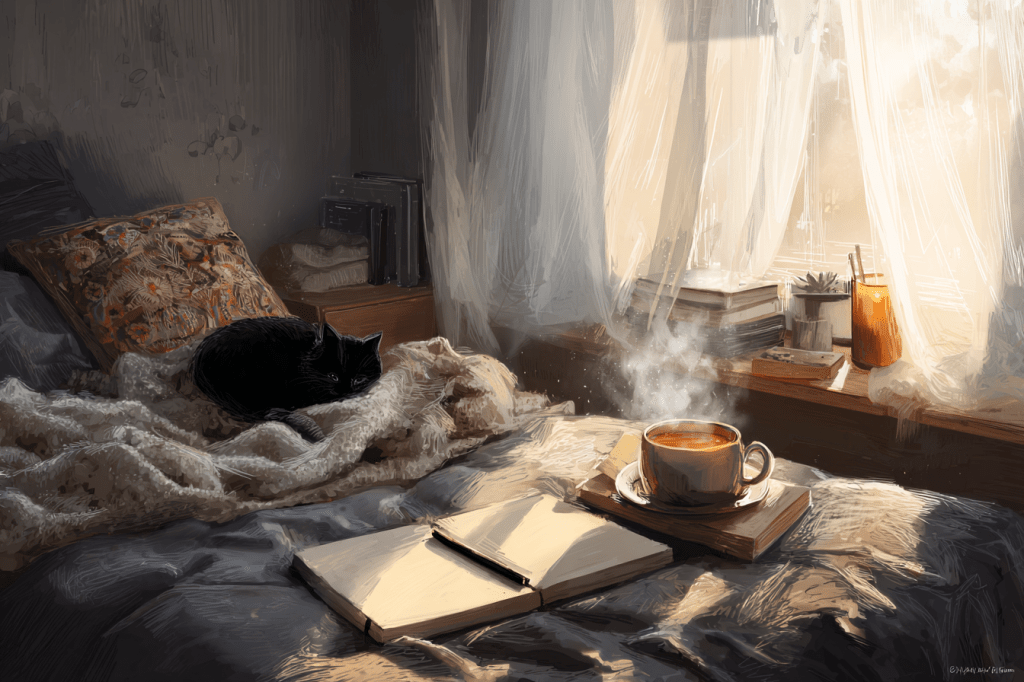
A steaming mug of tea rests beside an open notebook on a soft bed. Sunlight pours through sheer curtains, casting a warm glow across the room. A black cat sleeps on a pile of blankets, evoking quiet comfort and the gentle return to creativity.
This is what healing looks like, sunlight, stillness, and the quiet promise that the words will come back.

And when you’re ready, your stories will still be there, waiting.

If this post spoke to you, share it with another writer who might need a little reminder: the stories will still be there. And so will you.

Writing to Trend vs. Writing for Love: Which Path Works?

Hey fellow writers and book lovers,

Here’s the question gnawing at my brain lately: Should authors chase the trends, or stay true to their muse?

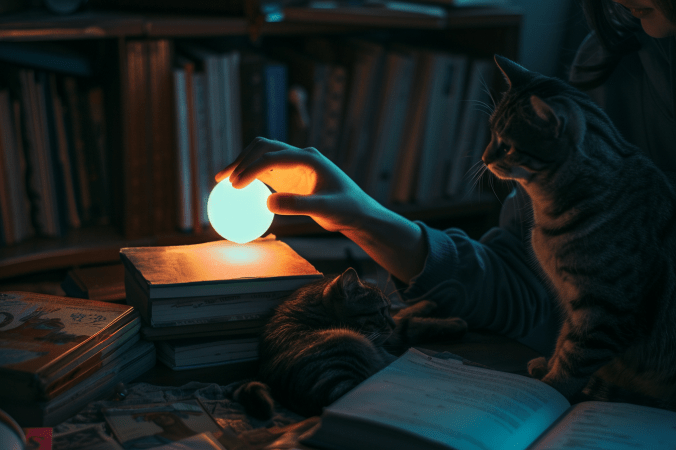
A writer's hand hovers over a softly glowing orb resting on a stack of books. One cat sleeps beside the books while another watches intently from the desk. The scene is dimly lit with a cozy, contemplative atmosphere, evoking creativity and decision-making.
The writer’s dilemma in one image: do you reach for the glowing idea, or follow the cat’s judgmental stare? Generated by Midjourney

Writing to trend means crafting a story that fits the current market buzz, trying to align with what agents, editors, or even readers on BookTok are asking for. Writing to passion? That means chasing the story that won’t leave you alone. The one whispering in your ear at 3AM. The one you’d write even if no one ever read it.

We’ve all seen it. The hot genre of the moment explodes and suddenly everyone’s writing cozy fantasies, romantasy with morally grey love interests, or spicy alien love triangles. And sure, if you hit that wave just right, you might land a publishing deal, an agent, or go viral on BookTok. Remember when dystopian YA ruled everything? Or when vampires were unavoidable? Trends are real, and they move fast. Writing to market can be tempting when you’re hoping to get traditionally published.

But what if your heart is pounding for a story that doesn’t quite fit the current mold?

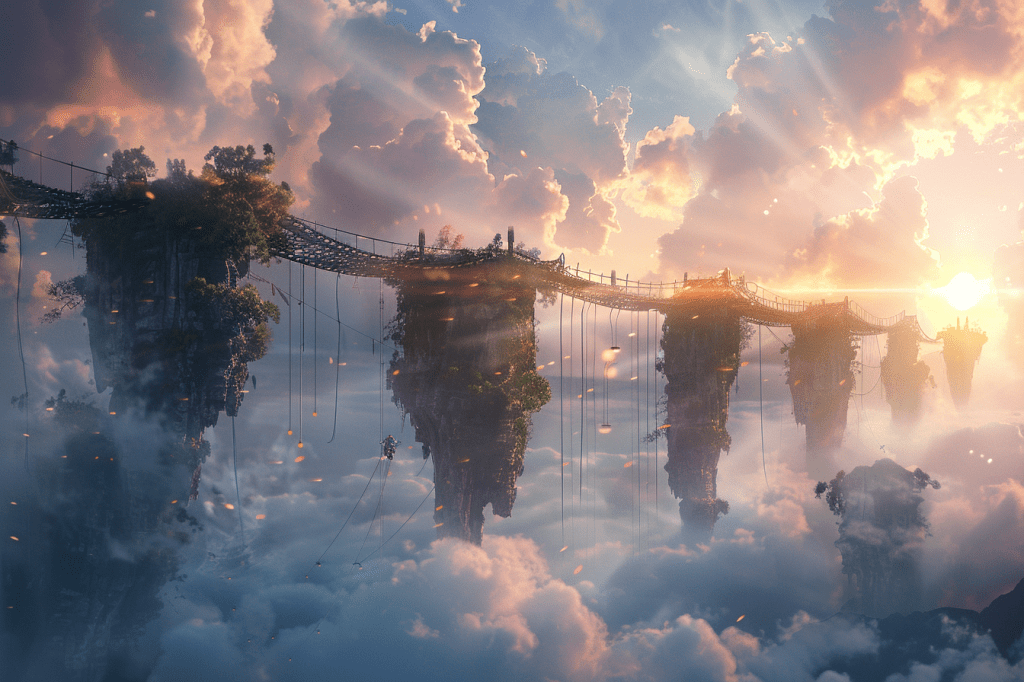
I’ve been wrestling with this exact thing. My Wind Riders series is world built, beloved, and fully alive in my head. Floating sky islands, brave aerial scouts riding their bonded companions through dangerous wind currents, strange corrupted storms, found family, sacrifice, grief, hope… I love the characters. I love the setting. I love the vibe.

Floating stone islands connected by rope bridges hang suspended in a glowing sky above the clouds, evoking a sense of magic, distance, and longing.
This is the world that still hums in the back of my mind… untethered, alive, and waiting. Generated by Midjourney

But I can see that it might not be trending right now. So I’ve been wondering… should I shelve it and try to develop something trend friendly? Something that better aligns with current book publishing trends or what’s hot on BookTok?

The thing is, the trend friendly story I’m eyeing? I genuinely love it too. It’s not just a shallow attempt to chase what’s hot, it’s been simmering in my brain for years, just waiting for its moment.

I won’t give away too much (yet), but it involves a woman grappling with a life she didn’t ask for, powers she doesn’t want, and a world that suddenly won’t leave her alone. There’s danger, heartache, and one very sarcastic cat who heckles her with the same intensity my cat Carmen reserves for whatever food I’m currently trying to eat. This one just happens to tick more of the boxes traditional publishing is looking for right now, especially if you’re writing with the market in mind.

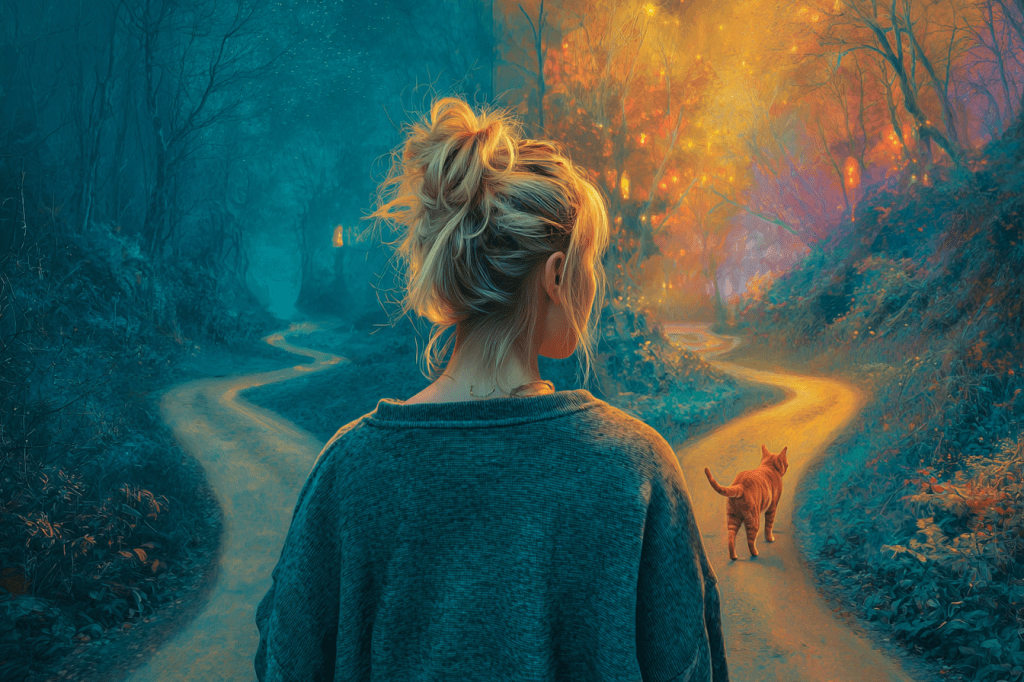
A woman with messy blonde hair stands at a fork in a forest path. One side is dark and shadowy, the other glows with warm magical light. A ginger cat walks ahead toward the glowing path.
Standing at the crossroads between heart and hustle. The cat, of course, already knows which way to go. Generated by Midjourney

So what do we do?

Do we write what sells? Do we write to market to improve our chances of getting published? Or do we write what sings?

Is it possible to do both?

Maybe there’s a hybrid path. Maybe we shape a passion project just a little more toward trend. Or we self publish what we love and query the marketable one. Maybe the trick is figuring out which story needs to be told right now, and which one can wait for its moment.

This post isn’t me giving you answers. It’s me asking questions. Honest ones. Because I think a lot of us are stuck here, especially those of us trying to navigate the publishing industry.

I want to know what you think.

Have you ever paused a beloved project because it wasn’t “sellable”? Or shelved something that felt like screaming into the void? Have you followed the market and found success or regret?

Are you team write-what-you-love, team write-to-sell, or somewhere tangled in between?

Drop your thoughts in the comments. Let’s talk about it.

Fixing Plot Holes in Fantasy Writing (with Help From the Next Generation)

I was elbows deep in Wind Riders fantasy worldbuilding, notes everywhere, cats prowling, tea long forgotten, when my daughter wandered in and casually asked, “What are you working on?”

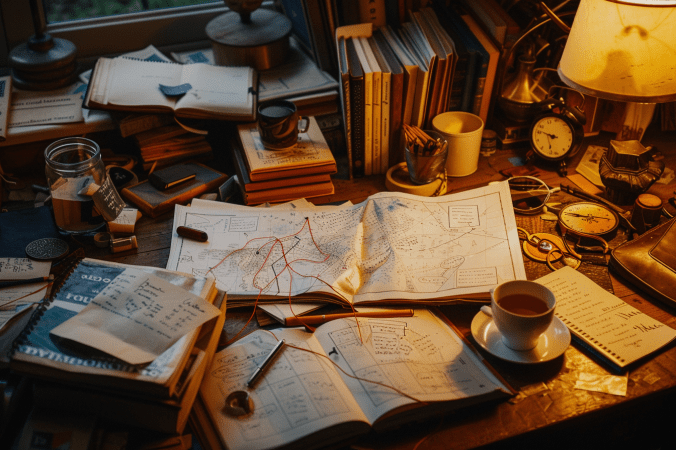
A cluttered writer’s desk filled with open notebooks, fantasy maps marked with red string, scribbled notes, scattered books, and a cup of tea under a warm lamp. The scene evokes cozy chaos and deep worldbuilding focus.
Where the chaos begins… notes, tea, and the occasional cat. (Image created by Midjourney)

What followed was a two-hour lore-dump-turned-interrogation that felt like a surprise writing sprint disguised as a conversation. Nyx the cat was displaced so she could take a seat (and gave us both the look of betrayal only a black cat can muster, complete with a drawn out whine of protest. Poor baby.), but the moment she sat down and started asking questions, something clicked… and kept clicking.

We talked through the Cataclysm, the rise of the Riders, the floating islands, and the process of fixing plot holes and developing stronger character arcs, bringing life to story ideas that had been gathering dust. The next thing we knew, two hours had passed. By the time we looked up, we’d unraveled the antagonist arc, reshaped a love interest dynamic, and, somehow, figured out how the first book ends.

I’m not going to tell you that part. Not yet. But I will say that somewhere between her raised eyebrow and my rambling, I realized something big: this isn’t a standalone story.

It’s a trilogy.

What started as a standalone suddenly stretched its wings. There were too many threads, too much heart, to wrap in one book. And somehow, that made it all feel more real.

You know that feeling when a puzzle piece slots in and suddenly the whole picture shifts into focus? That. It reminded me how powerful it is to talk things out with someone who isn’t inside your head. I’ve always been a worldbuilding-first kind of writer (you can read more about that here), but getting outside input shook loose some things I didn’t even realize were stuck. Bouncing ideas off someone who isn’t emotionally attached to that one scene you refuse to cut, or the backstory you secretly wrote five pages for? Invaluable.

A whimsical sky town perched on a large floating island above the clouds. Wooden bridges, windmills, lanterns, and rustic buildings glow in soft golden light as birds soar across the sky.
The kind of place my Wind Riders would call home… lanterns, walkways, and just enough altitude to make things interesting. (Image created by Midjourney)

And when that someone gets into it too? Starts pitching scenes back at you like a pro? It’s like biting into a story filled bonbon, surprising, rich, and just the right kind of sweet.

So yes, I got grilled today. Lovingly. And the result is a better story, a clearer arc, and a brain that’s buzzing with the kind of excitement that only comes from brainstorming a fantasy trilogy that finally works.

(Nyx remains unimpressed. I owe her a treat. Worth it.)

Working with Myth Without Taking What’s Not Yours

I love mythology like some people love true crime podcasts… obsessively, deeply, with a whiteboard, a lot of chocolate, and a steaming cup of green tea with peppermint. It’s a mess of names, symbolism, tragedy, transformation and just enough blood to keep it interesting. It’s the scaffolding under nearly every story I love and many I’ve written. But when you’re writing fiction that draws from real-world mythologies, things get complicated.

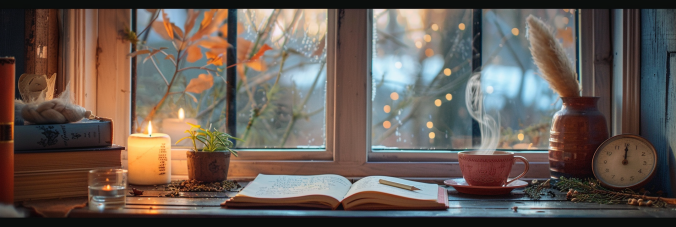
A softly lit writing desk near a window at dusk. An open notebook, a steaming teacup, flickering candles, and scattered greenery sit beneath a backdrop of bokeh lights and bare autumn branches.
Generated with Midjourney magic and exactly one too many cups of peppermint tea.


There’s something irresistible about mythology. It’s archetypal and raw and weird in all the right ways. It carries a current that hums under your skin. One obscure god or whispered folk ritual can ignite an entire novel concept. But it’s not a grab bag of “cool stuff” to mine without care. Especially when that mythology belongs to a culture you weren’t raised in.

Stories are sacred. And mythology? Mythology is a kind of living memory.

The trouble happens when we treat it like window dressing. When we turn someone’s spiritual practice into a costume, or flatten ancestral wisdom into a plot device. I’ve read stories that tried to be reverent but instead came off like the author skimmed the folklore section of Wikipedia, sprinkled a few foreign sounding names around, and called it homage.

I’m not interested in writing that kind of story.

When I pull from myth, especially from a culture not my own, I try to ask more than just “what can I use?” I ask, “what does this mean to the people who live it?” “How might it feel from the inside?” “Am I honoring this… or just wearing it?”

In the short story I worked on today, I drew inspiration from Norse death traditions. I didn’t want to copy and paste a funeral rite. That felt empty. Instead, I built around the feeling of being marked. I imagined two yew trees intertwined as a passage, and asked: what if this place remembered every grief that passed through it? What if the myth wasn’t a record, but a presence?

That’s the work.

Two massive yew trees with thick, entwined branches form a natural archway in a misty forest. Golden leaves, moss-covered roots, and faint lantern light create an ethereal, sacred atmosphere.
Midjourney conjured this. I just followed the path through the trees.


It’s not about erasing yourself or writing only within your lane, it’s about being a respectful guest in someone else’s house. It’s learning the stories before you retell them. It’s caring about more than the aesthetic.

Mythology is not a buffet.

It’s a language. A warning. A bridge.

And if you want to write with it, you better listen first.

If you love a culture’s stories, the best thing you can do is read the voices from within it. Learn from them. Buy their books. Amplify their work.

So I listen, with my notebook open, a candle lit, and cats occasionally trampling across my outlines. That’s where the myth begins for me.

Worldbuilding: A Cautionary Tale in Too Many Tabs

Worldbuilding starts innocently enough. You name a kingdom. Maybe draw a map. Maybe throw in a couple of gods, a weird storm, a family tree with just enough trauma to be narratively satisfying.

A cozy, cluttered writer’s desk bathed in soft light. A black cat lounges across hand-drawn fantasy maps and scattered notes. A pink teacup sits nearby, surrounded by vintage books, wildflowers, and the charming chaos of worldbuilding.
Nyx, in her natural habitat: guarding the map she will never let you finish. Somewhere under that paw is a vital plot point. We’ll never know. Image created by Midjourney.

Then one day you blink and realize you’ve written a 3,000 word document on sky island crop rotation. You can’t remember your own birthday, but you know which fictional provinces export fermented windfruit and why their trade alliance fell apart in Cycle 617.

This post? It’s a love letter. And a warning.

People think you have to know everything before you start, but if you did, we’d all be frozen in “research” mode until the sun exploded. It doesn’t need to be logical either, it just needs to feel true to your world. And no, it’s not just for fantasy authors. If you made up a cozy town with suspiciously nosy neighbors and a bakery that mysteriously never runs out of raspberry scones… congratulations, you’re one of us.

Worldbuilding is part chaos magic, part archaeology. You’re not building a world, you’re excavating one you barely understand, with a pen instead of a shovel and caffeine instead of common sense.

It’s balancing six cultural systems, a magic rule you regret inventing, and a civil war you vaguely alluded to in chapter two that now demands three pages of backstory and a hand drawn battle map.

It’s naming things like a drunk linguist. It’s opening your notebook and realizing you’ve contradicted your own timeline in three different places and somehow invented a holiday that happens every thirteen days.
It’s divine, maddening, and wildly inefficient.

And sometimes… it’s dangerous.

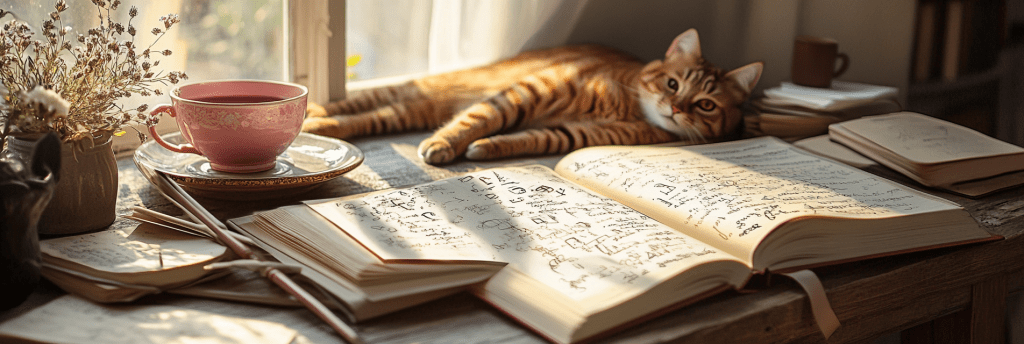
A cozy cottagecore writing desk in warm, natural light. A long orange cat sprawls across open notebooks filled with fictional alphabets and scribbled translations. A tipped pink teacup stains scattered parchment, while quills, ink smudges, and wildflowers complete the scene of whimsical worldbuilding chaos.
Finnegan, master of stretching, spilling tea, and rewriting your language system with one well-timed flop. Chaos is his comfort zone. Image created by Midjourney.


Because once the worldbuilding black hole opens up, it sucks you in. Suddenly it’s 2 a.m., your eyes are dry, your tea is cold, and the story you meant to write has been sitting untouched like a gentleman caller you stood up on the porch, in the rain, with flowers. And bless it, the poor thing’s still waiting for you.

But despite all that, there’s this moment, if you’re lucky, when you zoom out and realize it all fits together. Like the world was waiting for you to stumble onto it. When a reader points out a connection between two pieces of lore and you’re like, Yes, I did that on purpose absolutely I am a genius.

Or when a character walks into a room and you know what’s on the walls, what year it was built, who buried a secret in the floorboards, and why the ceiling still leaks. I may not use everything I know in that moment, but in the future, who knows?

It’s tea-stained madness with a side of purpose.

Maybe it’s punishment. Maybe it’s passion.

Probably both.

Because let’s be honest, I don’t worldbuild because I have to. I worldbuild because I can’t not. I’m already asking “what if” a hundred times a day. I might as well write it down and charge my protagonists emotional interest.

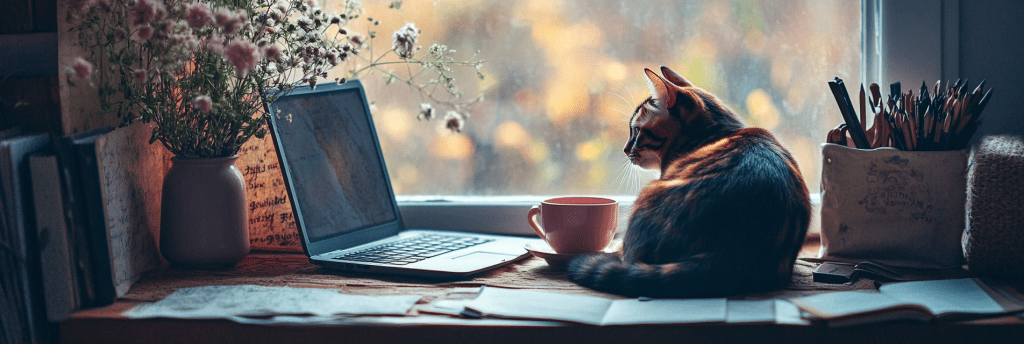
A cozy writer’s desk in warm ambient light. A tortoiseshell cat sits curled atop an open laptop beside a pink teacup, gazing thoughtfully out the window. Scattered notes, wildflowers in a vase, and a container of pens and quills complete the soft, creative chaos.
Carmen, as she exists in spirit and judgment. Image created with Midjourney.

Also? It’s fun. Fungi-powered cities? Sentient storms? An economy based on literal hot air? I’m not just building a world, I’m raising it like a feral child I fully intend to unleash on readers.

What’s the weirdest rabbit hole you’ve fallen into while worldbuilding? Calendar math? Magical sewage systems? A military hierarchy based on fish?

Tell me in the comments. Validate me. Share the pain. Maybe bring snacks.

And stay tuned, I’ll be opening the doors to some of my multiversal chaos soon in a section called My Worlds, where you can marvel (or panic) at the sheer number of universes I’m juggling like a gremlin with a tea addiction.

Because why write one world… when you can write twelve?